News at FSUCML

Mercury on the Rise in Goliath Grouper


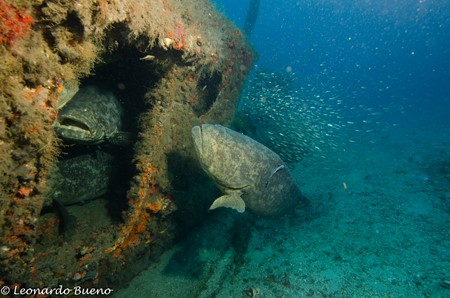
A new study led by former FSUCML graduate student Dr. Chris Malinowski (Dr. Felicia Coleman and Dr. Chris Koenig’s lab) investigates the health and reproductive consequences of mercury toxicity on Goliath Grouper (Epinephelus itajara). This newly published paper builds off of their two previous manuscripts: one on spatial mercury patterns in Goliath Grouper off the coasts of Florida (2019) and the other a baseline health assessment of Goliath Grouper (2020).
Coleman and Koenig Participating in Study of Pulley’s Ridge Fishes


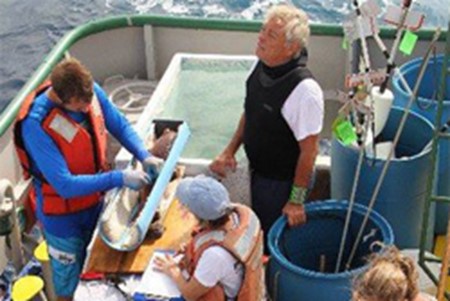
Dr. Felicia Coleman and Dr. Christopher Koenig, accompanied by grad student Chris Malinowski, are onboard the RV Walton Smith (the ship after which the R/V Apalachee was modeled) conducting research in Pulley’s Ridge and the Tortugas, 350 miles from Miami, where the cruise set sail. The objectives are to determine the density of red grouper in selected sites, and to determine whether fish living here are related to fish turning up in coastal sites like Florida Bay.

Coleman and Koenig Fish for Reasons Behind Endangered Grouper's Comeback


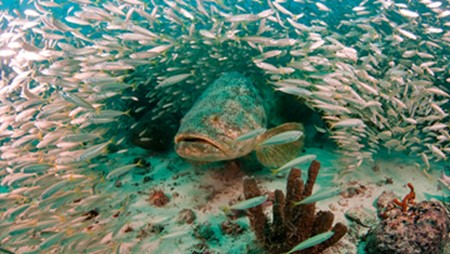
FSUCML faculty, Dr. Christopher Koenig and Dr. Felicia Coleman, are collecting new data on the once severely-overfished Atlantic goliath grouper in a new three-year study. The species is native to Florida's waters, and is currently making a comeback in the southeastern United States, after a 21-year fishing moratorium. Using nondestructive sampling techniques, Koenig and Coleman will examine specific conditions and behaviors supporting this species' population recovery along Florida's coastlines in both the Atlantic Ocean and Gulf of Mexico.

Northern Gulf Institute Awards $500,000 to FSUCML, COAPS, and the Departments of Biological Science and Earth, Ocean, and Atmospheric Science to conduct research on the oil spill


The study, Impact of crude oil on coastal and ocean environments of the West Florida Shelf and Big Bend Region from the shoreline to the continental Shelf Edge, represents an integrated, rapid-response study of the impact of oil on coastal and ocean marine ecosystems of the northeastern Gulf of Mexico, including the northern West Florida Shelf from the Big Bend Region west to Louisiana, that can be completed in its entirety within 5 months.